Spearheaded by Markus Klammer, the #brainheartlab published a new paper in the European Stroke Journal
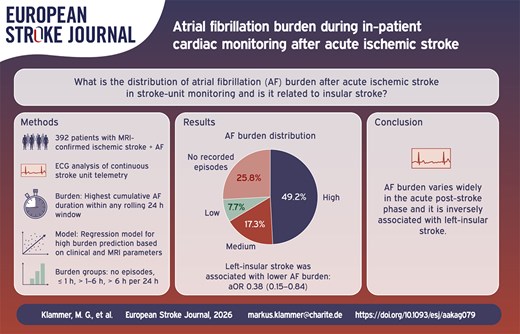
In a retrospective cohort of 392 patients with MRI-confirmed ischaemic stroke and AF, we observed marked heterogeneity in AF burden during early in-hospital telemetry and identified three notable findings:
🧠 Insular laterality: Left insular infarction was associated with a lower likelihood of high AF burden, while right insular involvement showed a signal towards higher AF burden, supporting a role for hemispheric autonomic regulation (left insula = 🛑 ; right insula = 🌪️)
🕒 Circadian dynamics: First AF episodes clustered in the early evening, whereas early morning AF episodes were consistently least frequent
⚡ Early transient AF: Among patients with known stroke onset, almost half had AF detected only within the first 48 hours after stroke onset, highlighting the dynamic nature of AF during the acute phase (➡️ early transient neurogenic AF?)
Together, these hypothesis-generating findings suggest that integrating lesion location, circadian biology, and temporal AF dynamics may improve our understanding of AF after stroke and help inform future rhythm monitoring strategies.

